A question opens the route
The first scene asks for a precise relation, not a random fact.
Text game about geography, history and causality
Verunis turns curiosity into a route through the Atlas. You choose links between countries, eras, people and events, then see which explanation holds and which elegant mistake opens a Shadow.
Erudition begins when a fact finds its cause.
Each choice connects place, time and consequence so a short session can leave more than a correct answer.
The world as a route
Countries, eras, people and events are not isolated cards. In Verunis they become a route: a chain of choices where a place, a date and a consequence remain connected.
The goal is not to collect isolated right answers, but to build a bearing across the world.
The first scene asks for a precise relation, not a random fact.
A chosen link moves the route across country, era, person or event.
Geography gives pressure, distance and terrain; chronology gives buildup and aftermath.
The opened relation remains visible in the Atlas instead of disappearing after the score.
Legend of the Atlas
Canonical route
The Atlas is the verified layer: facts, chronology, institutions and causal links that can carry the weight of explanation.
In the Atlas, every step is tied to context, evidence and consequence.
Drift and distortion
The Shadows are not fantasy. They are the diagnostic space of plausible distortions: myths, over-simple causes and elegant but unstable explanations.
The point is to understand why an error can attract belief, then find the Anchor that returns the route to causality.
Drift into the Shadows
A wrong answer is not just a red mark. If the mistake is plausible, it can open a drift into the Shadows of the Atlas, where the game explains why that error attracts belief.
A complex historical process collapses into one convenient factor.
Cause and consequence swap places because hindsight makes the wrong direction feel obvious.
A polished story from the winning side pushes messier evidence out of view.
A route returns through an Atlas Anchor: a harder decision that separates the false mechanism from the verified chain.
The Atlas challenge
The challenge is quiet, but not soft. Verunis asks whether you can resist the attractive shortcut and build a chain that still holds when geography, chronology and evidence push back.
The easiest explanation is often the first Shadow. The game makes that temptation visible before it corrects it.
A strong answer connects cause, mechanism and consequence, not just a famous name to a famous event.
A wrong turn can still teach if the route shows why it was persuasive and where it breaks.
How an expedition works
An expedition begins with a direction: country, era, person, event or theme. From there, each scene asks for a relation that can move the route forward.
Before the choice, the game does not expose correctness, drift or hidden effects. After the choice, it shows what held, what bent, and what returns the route to the Atlas.
Choose a direction or accept a suggested route through the Atlas.
Read a compact scene where place, time and evidence are already in tension.
Choose the link that best connects cause, mechanism and consequence.
See the reveal: why the stable link worked, or why the Shadow was persuasive.
The result leaves a trace in the map, timeline, library and personal atlas.
Text game with visual support
Text
The main action is reading, choosing, doubting and interpreting the consequence of a choice.
Scene
Maps, routes, timelines, nodes and shadow branches show what the choice changed.
Intelligence
Maestro and the runtime can adapt short reactions, but the factual ground stays curated and validated.
Format
The promise is not spectacle. The promise is a clearer sense of how places, eras and causes connect.
Maestro
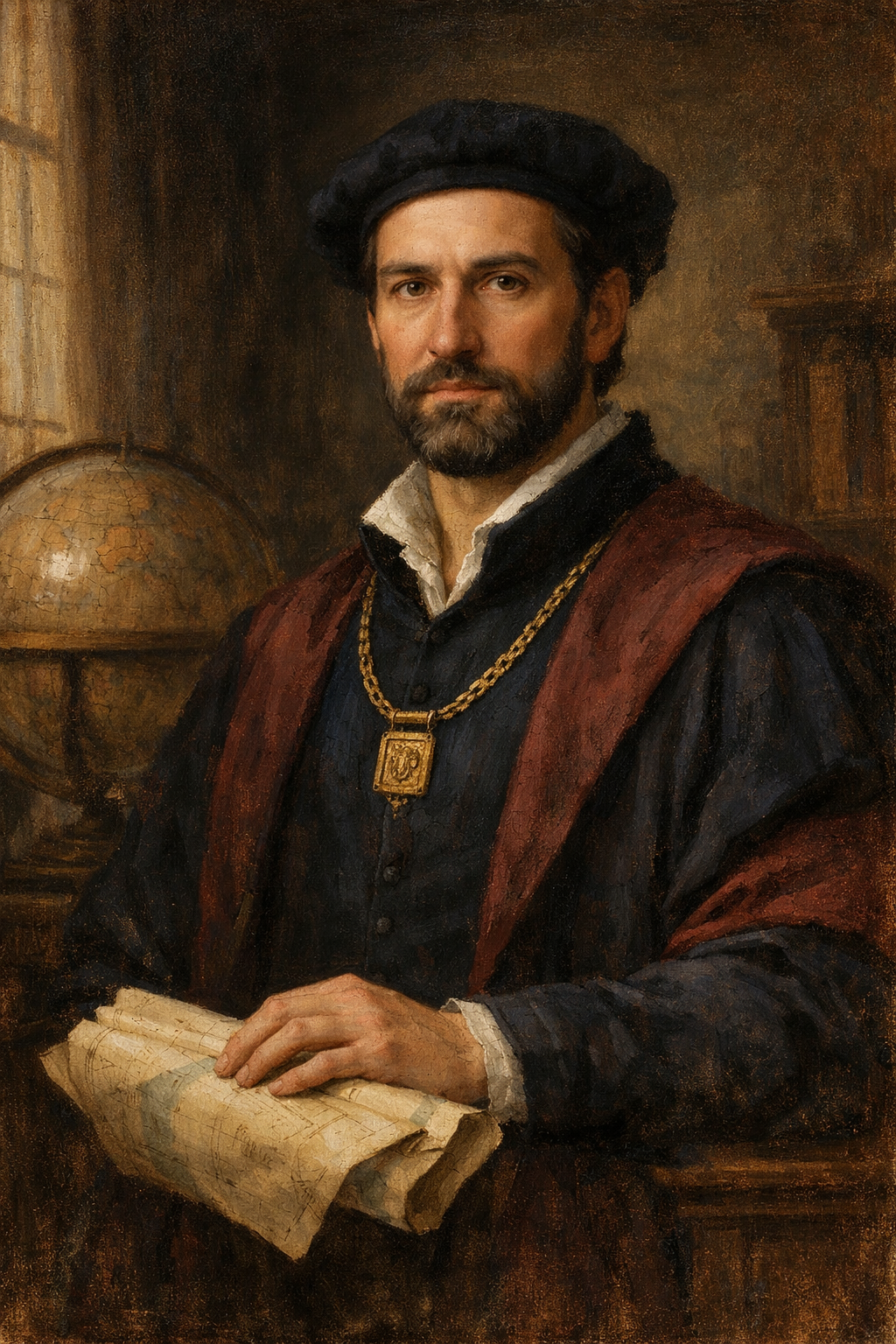
Maestro is a cultivated companion inside the game. He notices the route you just took, cuts away noise, challenges overconfidence and adds a brief line when the moment needs pressure or wit.
He clarifies instead of performing.
He does not confuse speed with understanding.
He can puncture overconfidence without turning into a clown.
How he sounds
Correct. Now explain why that port mattered before you congratulate yourself.
Maestro
A bold answer. A capital without context is only a better-publicized word.
Maestro
Reasonable. History tends to reward those who can separate cause from decoration.
Maestro
No idle chatter. No universal tutor pose. Short reactions, harder questions, dry humor and a clear boundary around what the game knows.
What grows in the player
Climate, terrain, distance and resources stop being background and start explaining political pressure.
Events gain order: buildup, simultaneity and aftermath become easier to read.
The game trains attention to mechanisms instead of treating causes as labels attached to outcomes.
Art, institutions, religion and language become evidence of how an age understands itself.
Opened facts settle into a personal atlas and remain useful after the result screen disappears.
Map, timeline and library
The Atlas is not a decorative backdrop. It is where opened routes, facts, explanations and mistakes remain readable after the question ends.
Geography shows pressure, distance, terrain and zones of influence.
Chronology makes buildup, simultaneity and consequence visible across cultures.
Collected facts, articles and explanations stay available for later routes.
Passed expeditions and discovered links form a readable route memory.
Atlas volume
The point is not inventory for its own sake. The point is that progress can be seen across place, argument and time.
Live counters will return when published atlas data is available again.
Route example
Imagine a route about cultural memory. Several answers may look respectable: geography, dynastic policy, a later myth, a schoolbook shortcut. The Atlas asks which link actually survives the route.
The place matters, but terrain alone cannot explain why the memory survived.
A stronger route connects institution, event, symbol and repeated retelling.
A neat explanation sounds elegant until the timeline forces it to carry too much weight.
One cause is made to do the work of a whole system.
A later result is mistaken for the force that created it.
A familiar national story is treated as if it were the evidence itself.
A local fact is stretched into a civilizational explanation too quickly.
Who it is for
Verunis is for players who like history, geography, systems and the feeling that a good question can make the world less flat.
FAQ
No. Questions are the doorway. The real value is explanation, route memory, geography, chronology and causality.
No. Maestro is bounded: he reacts to your route, presses for precision and gives short commentary. He does not invent facts or replace the prepared Atlas.
Yes. The core is useful by itself. Paid depth can expand routes and structure later, but the foundation is not amputated.
Yes. The intended loop is compact: scene, choice, reveal, next step. The session can be short while the context continues to accumulate.
No. Verunis is a game about orientation and erudition, not a substitute for full study. It makes serious reading easier to begin and easier to connect.
Verunis
A short route can leave a better map in the head: where a place sits, what came before it, what changed after it and which explanation was too neat to trust.